

Why Does My Candle Look Different After It Cools?
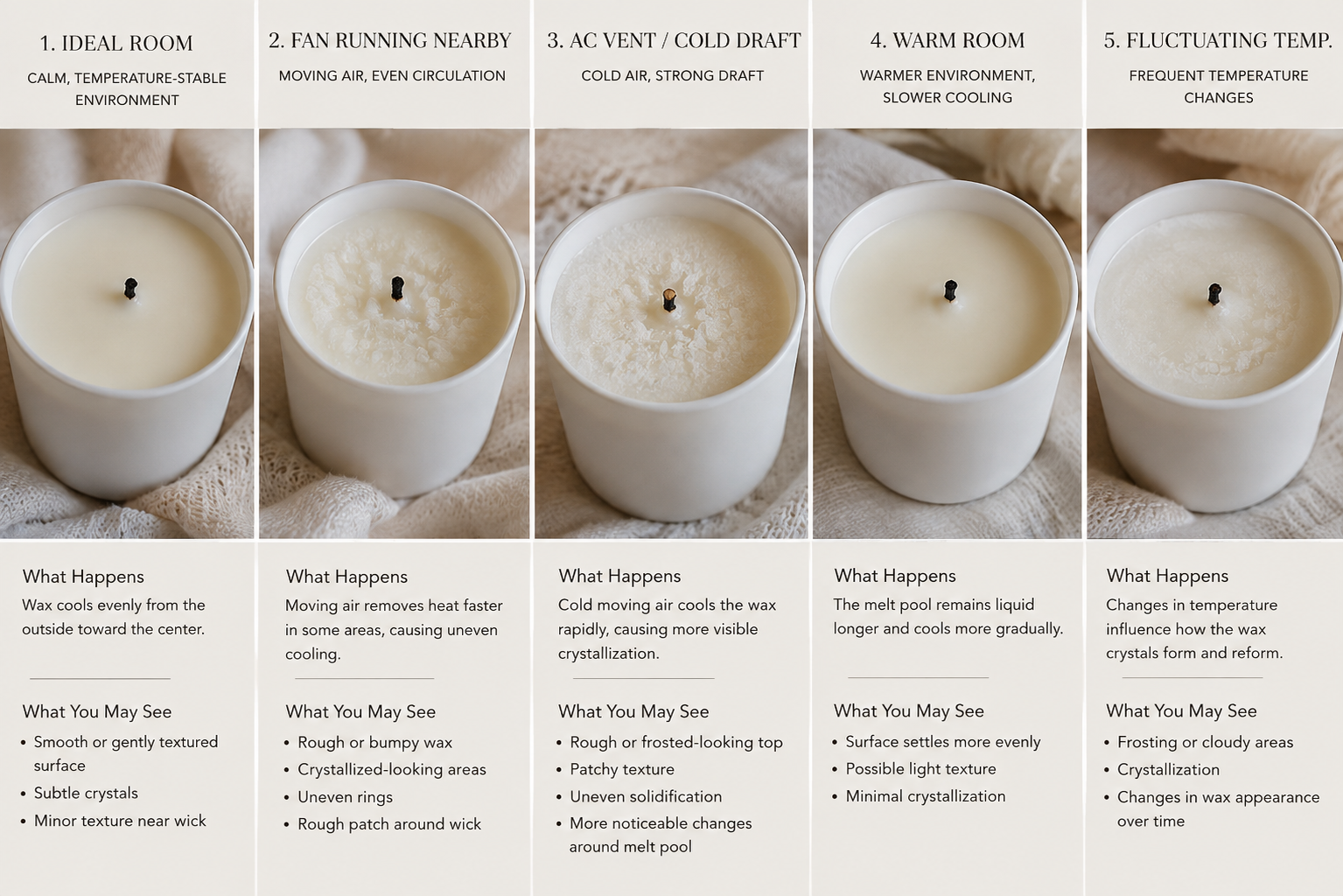
When you extinguish your candle, the wax doesn't immediately become solid again. The warm melt pool gradually cools and re-solidifies. During this process, the environment surrounding your candle can influence how evenly the wax cools and what the finished surface looks like.
For natural soy wax candles, a perfectly smooth surface doesn’t always happen. Soy wax naturally forms crystals as it solidifies, so texture after burning is normal and doesn’t mean there is anything wrong with your candle.
1. Calm, Temperature-Stable Room — More Even Cooling
Environment:
Approximately 70–75°F • No fan • No direct AC • No open window • Minimal airflow
What happens:
After the flame is extinguished, the melt pool gradually cools from the outside toward the center. Keeping conditions as consistent as possible, the wax has an opportunity to solidify more evenly.
What you may see:
A relatively smooth or gently textured surface, slight crystallization, subtle rings around the previous melt pool, or minor texture near the wick.
Takeaway:
This is the ideal environment for allowing your candle to cool naturally after each burn.
2. Fan Running Nearby — Faster & Uneven Cooling
Environment:
Ceiling fan • Table fan • Strong circulating air
What happens:
Moving air can remove heat from parts of the candle faster than others. Instead of the entire melt pool cooling at the same rate, one area can begin solidifying while another remains warmer.
That difference can cause more noticeable crystallization and an irregular surface. Even airflow from a ceiling fan can create uneven soy-wax cooling.
What you may see:
Rough or bumpy wax, crystallized-looking areas, uneven rings, rippling or a rough patch around the wick.
Takeaway:
If your candle develops a textured top after burning, airflow may be contributing. Allow it to cool away from fans and drafts.
3. Air-Conditioning Vent or Cold Draft — Rapid Cooling
Environment:
Near an AC vent • Cold room • Open window in cool weather • Strong draft
What happens:
Cold moving air can cool the exposed wax rapidly. Natural soy wax can be sensitive to temperature changes as it reforms. Rapid cooling and drafts are associated with more visible frosting/crystallization.
What you may see:
A rough top, white or frosted-looking crystals, patchy texture, uneven solidification or more noticeable changes around the melt pool.
Takeaway:
Keep your candle away from AC vents and cold drafts while burning and while the wax is cooling afterward.
4. Warm Room — Slower Cooling
Environment:
Warmer room • No direct airflow • Stable temperature
What happens:
The melt pool remains liquid longer and solidifies more gradually.
What you may see:
The surface may settle evenly, although soy wax can still develop some texture as it recrystallizes.
Extremely warm storage conditions aren't ideal either, however. Excessive heat can affect wax and fragrance over time.
Takeaway:
Consistency matters more than trying to keep your candle particularly warm or cold.
5. Room With Changing Temperatures
Environment:
Heating/AC repeatedly turning on and off • Candle moved between warm and cool rooms • Sunny windowsill that cools later
What happens:
Repeated temperature changes influence the way natural soy wax crystals form and reform.
What you may see:
Frosting, cloudy areas, crystallization or changes in the wax's appearance over time. Temperature fluctuations are one of the conditions associated with visible soy crystallization.
Takeaway:
A candle is happiest in a stable environment away from dramatic temperature changes.
The Important Part: Texture Doesn't Mean Your Candle Is Bad
Natural wax doesn't always return to its original factory-smooth appearance after being burned.
A rough, rippled or crystallized surface can simply be the result of the soy wax melting and then forming new crystals as it cools. Rough tops after burning are recognized as a common characteristic of soy wax.
It doesn't automatically mean the candle is defective, old or improperly made.
Candle Cooling Tip
After extinguishing your candle:
Allow the wax to cool completely before moving it. Keep the candle away from fans, open windows and direct air-conditioning. A calm, temperature-stable environment gives the melted wax the best opportunity to cool evenly.
And don't worry if the surface looks a little different after each burn — those small variations are part of the natural character of soy wax.